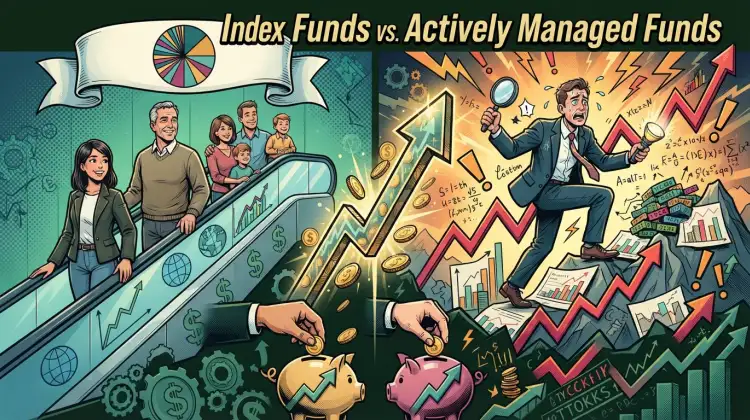
If you are building wealth through the markets, one of the first decisions you will face is whether to buy index funds or actively managed funds. Both are pooled investment vehicles that let you own hundreds of stocks or bonds in a single purchase, but they operate on very different philosophies. Index funds try to match a market benchmark at the lowest possible cost. Actively managed funds pay professionals to try to beat that benchmark. Understanding the trade-offs between cost, performance, taxes, and risk is essential before you commit your money.
What Is an Index Fund?
An index fund is a mutual fund or exchange-traded fund (ETF) designed to track a specific benchmark, such as the S&P 500 or the Bloomberg U.S. Aggregate Bond Index. The fund holds the securities in that index in roughly the same proportions, so its returns mirror the index minus a small expense ratio.
Because there is no team of analysts picking stocks, index funds are inexpensive to run. Many broad-market index funds charge expense ratios well under 0.10%, and some major providers offer ratios of 0.03% or lower. They are also highly transparent: you generally know what the fund owns, and portfolio turnover is low, which tends to make them tax-efficient in taxable accounts.
What Is an Actively Managed Fund?
An actively managed fund employs a portfolio manager and research team who buy and sell securities based on analysis, forecasts, or a stated strategy. The goal is to outperform a benchmark or to deliver a specific outcome, such as lower volatility or income generation.
That professional management comes at a price. According to the Investment Company Institute, the average expense ratio for actively managed equity mutual funds has historically been several times higher than for index equity funds, often in the 0.5% to 1.0% range or more. Higher turnover can also generate more capital gains distributions, creating a tax drag for investors holding these funds in taxable brokerage accounts.
Costs and the Compounding Drag
Fees matter more than many investors realize because they compound against you. A 1% annual expense ratio sounds small, but over 30 years it can consume a meaningful share of your ending balance compared with a fund charging 0.05%. The difference shows up not just in the fee itself but in the lost growth on the money paid in fees.
- Index funds: Low expense ratios, minimal trading costs, and low turnover.
- Active funds: Higher expense ratios, plus potential sales loads, trading costs, and tax inefficiency.
Cost is the most reliable predictor of relative performance. A fund that charges more must generate higher gross returns just to match a cheaper alternative.
Performance: Can Active Managers Beat the Market?
SPIVA scorecards published by S&P Dow Jones Indices have consistently found that the majority of active large-cap U.S. equity funds underperform the S&P 500 over 10- and 15-year periods. The gap widens over longer horizons because few managers sustain outperformance after fees.
That does not mean active management never wins. Some managers add value in less efficient areas such as small-cap stocks, emerging markets, or certain bond sectors. But identifying those managers in advance is difficult, and past performance does not reliably predict future results. For most long-term investors, a low-cost index approach offers a higher probability of capturing market returns.
Risk, Taxes, and Behavioral Considerations
Index funds carry market risk by design: when the index falls, the fund falls with it. Active managers may attempt to limit losses through defensive positioning, though research suggests few do so consistently.
Taxes are another differentiator. Low-turnover index funds typically distribute fewer capital gains, which is valuable in a taxable account. Active funds that trade frequently can hand you taxable gains even in a down year. On the behavioral side, index funds are simple to hold through volatility, while active funds may tempt investors to chase recent winners, a habit that often hurts returns.
How to Decide for Your Portfolio
For most investors saving for retirement or other long-term goals, a core of low-cost, broadly diversified index funds is a sensible foundation. You can hold them in a 401(k), an IRA, or a taxable brokerage account. If you want to add active funds, treat them as a satellite allocation and evaluate them on total cost, manager tenure, process consistency, and tax efficiency.
- Prioritize low costs and broad diversification.
- Compare each fund against an appropriate benchmark over full market cycles.
- Consider your tax situation and account type.
- Avoid switching strategies based on short-term performance.
The Short Version
Index funds offer low costs, transparency, and a strong track record of matching market returns, making them a reliable core holding for most investors. Actively managed funds can add value in select niches, but higher fees and inconsistent outperformance make them a harder case for the bulk of your portfolio. Start with low-cost index funds, keep fees low, and only add active management where you have a clear, evidence-based reason to do so.







