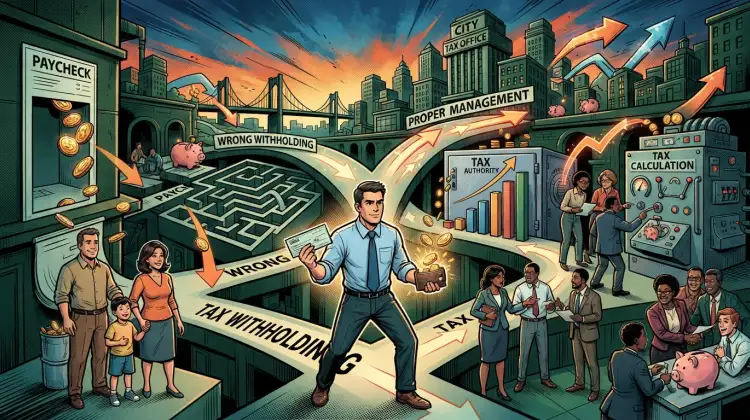
Understanding tax withholding is one of the most practical pieces of financial knowledge you can have. Withholding is the mechanism by which your employer sends part of each paycheck to the IRS on your behalf, and getting it right determines whether you owe money in April, receive a refund, or come close to breaking even. This guide explains how the system works, how to fill out Form W-4 correctly, and when to revisit your settings.
What Tax Withholding Actually Is
Federal income tax in the United States is a pay-as-you-go system. Rather than collecting one large payment at year-end, the IRS requires tax to be paid throughout the year. For employees, this happens through withholding: your employer calculates an amount to deduct from each paycheck based on your W-4 and the IRS withholding tables, then remits it to the government.
Withholding is not a separate tax. It is an advance payment toward the income tax you will ultimately owe. When you file your return, the IRS compares total withholding plus any estimated payments against your actual tax liability. Overpay and you get a refund; underpay and you send a check.
Self-employed people and those with significant non-wage income do not have an employer to withhold for them, so they typically make quarterly estimated tax payments instead.
How Form W-4 Drives Your Withholding
Form W-4, the Employee's Withholding Certificate, is the document that tells your employer how much to withhold. The form was redesigned for 2020 and no longer uses withholding allowances. Instead, it relies on a few key inputs:
- Filing status: Single, married filing jointly, or head of household.
- Multiple jobs or a working spouse: A checkbox and worksheet that adjust for combined income.
- Dependents: A credit amount for qualifying children and other dependents.
- Other income and deductions: Lines for interest, dividends, or itemized deductions that affect your taxable income.
- Extra withholding: A flat dollar amount you can add to each paycheck.
If you leave the W-4 blank, your employer withholds as if you are single with no other adjustments. That default is often too high for married couples with one earner and too low for people with side income.
Why Your Refund Is Not a Bonus
A large refund feels good, but it means you lent money to the government interest-free for up to a year. Conversely, a large balance due can trigger underpayment penalties if you did not pay enough tax during the year. The IRS generally expects you to pay at least 90% of your current-year tax or 100% of last year's tax (110% for higher earners) to avoid a penalty.
The goal of good withholding planning is to land close to zero—neither a big refund nor a big bill. That puts more money in your pocket throughout the year, where it can earn interest or cover expenses.
When to Revisit Your Withholding
Life changes are the main reason withholding drifts out of alignment. Review your W-4 after any of these events:
- Getting married, divorced, or widowed
- Having or adopting a child
- Starting or losing a second job, or a spouse starting work
- A significant raise, bonus, or change in pay structure
- Beginning to receive investment, rental, or gig income
- Buying a home or making large charitable gifts that change your deductions
The IRS Tax Withholding Estimator is a free tool that walks you through your pay stubs and prior return to recommend a W-4 setting. You can submit a new W-4 to your employer at any time; it takes effect with the next payroll cycle.
Withholding vs. Estimated Payments
Wage earners rely on withholding, but many people have income that is not covered by an employer. Freelance work, dividends, capital gains, and rental income all require estimated tax payments, typically made quarterly using Form 1040-ES. Withholding is generally preferred when available because it is treated as paid evenly throughout the year, which can reduce underpayment penalty exposure. If you have both wages and side income, you can often increase withholding on your W-4 to cover the extra tax instead of making separate estimated payments.
What to Remember
Tax withholding is a pay-as-you-go system, not a tax itself. Your W-4 controls how much is taken from each paycheck, and the right setting depends on your filing status, other income, and dependents. Review it after major life changes, aim for a small refund or small balance due rather than a large one, and remember that non-wage income usually requires estimated payments. A few minutes with the IRS Tax Withholding Estimator each year is one of the highest-return financial habits you can build.







